
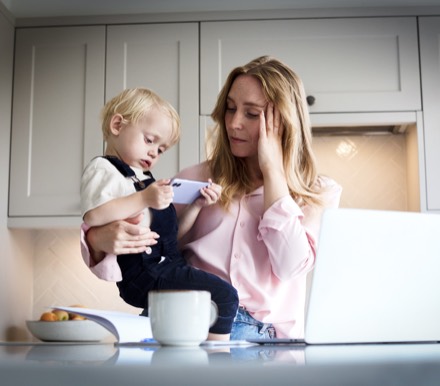
Can I describe a feeling and you tell me if you know it? Someone is touching you. Someone is also saying your name for the ninth time in a row. There's a show blaring and a toy that plays a tinny song and a fork scraping a plate, and somewhere in your chest a wire pulls tight, and you have the sudden, alarming urge to run out of your own front door and stand in the street. Not because you don't love them. Because your body is full and there is no more room.
That's sensory overwhelm, and if you've felt it, you're not broken and you're not a bad parent. You're a person whose senses have a limit, parenting in an environment that blows right past that limit most days. The touching alone is relentless. Little kids climb and cling and pat and pull, and by evening your skin can feel like it belongs to everyone but you.
It builds, and then it spikes
The thing about overstimulation is that it's usually not one loud moment. It's accumulation. Every noise, every request, every physical demand adds a little to the pile, and for most of the day you carry the pile fine. Then one more sound lands, a totally ordinary sound, and you snap in a way that feels wildly out of proportion to what just happened.
It's out of proportion to that one thing. It's exactly in proportion to the whole pile. Naming it that way helped me stop treating my reaction as evidence I was failing, and start treating it as data. The spike means the load got too high a while ago. It means I needed a break long before I actually took one.
If you're a parent who runs sensitive to sound or touch to begin with, and plenty of us do, this isn't a moral failing you need to push through. It's a real feature of how your system works, and it deserves accommodation the same way anything else would.
Stepping away is allowed. Actually allowed.
Here's the belief we have to gently put down: that a good parent absorbs infinite input without ever needing to escape it. That's not devotion, it's a recipe for the exact blowup you're trying to avoid. Stepping away for sixty seconds before you're at the edge is one of the most caring things you can do, for them and for you.
What that can look like, depending on how old your kids are and how much you've got left:
- If they're safe, put them somewhere contained and walk into another room. The bathroom counts. Close the door. Run the tap and put your wrists under cold water and just breathe for a minute. This is not neglect. This is maintenance.
- Take the sound down first, because sound is often the loudest part of the pile. Mute the tablet. Turn off the toy. Even a few seconds of lower volume gives your system somewhere to land.
- Get the touch off your skin for a moment. "I need my body for one minute, then you can have a hug." You're allowed to have a body that's yours sometimes. Teaching them that is a gift, not a rejection.
- Narrate it honestly and calmly. "My ears are really full right now. I'm going to take a quiet minute." No shame, no drama. You're modeling exactly the self-awareness you hope they'll grow into.
None of these make you cold. A parent who takes a breath and comes back regulated is worth ten of a parent who white-knuckles it and erupts. Your kid does not need you maxed out and resentful. They need you around and reachable, and sometimes the only road to reachable is a locked bathroom door for ninety seconds.
Lowering the baseline, not just the spikes
The in-the-moment stuff helps, but the deeper relief comes from carrying less on an ordinary day, so you have more headroom before the pile gets tall. A big, sneaky source of overstimulation isn't even the sensory input. It's the mental channel running underneath it, the one tracking appointments and permission slips and what's for dinner while the actual noise plays on top. That background hum eats capacity you don't know you're spending.
Getting that mental track out of your head and into something you trust doesn't quiet the room, but it quiets you, which turns out to be most of the battle. It's part of why we made Relief Mode for the hardest, lowest-energy days, a stripped-back version that asks almost nothing of you when you have almost nothing to give. Because some days the goal isn't to optimize anything. It's just to get through the evening with your nervous system mostly intact.
You are not too sensitive. You are not doing this wrong. You're a human being with human limits, loving some very loud, very needy small people. Take the minute. They'll be okay, and you'll come back more yourself, which is the whole point.