
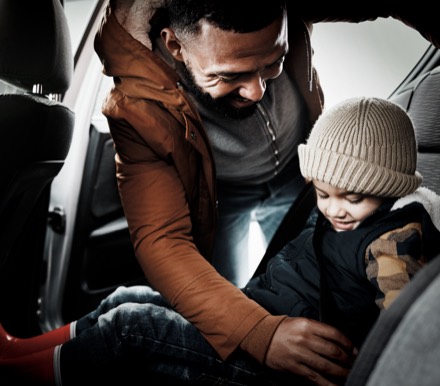
There's a specific kind of quiet that settles over a kid on transition day. Some get clingy. Some get spiky and pick a fight over nothing an hour before pickup. Some go strangely calm in a way that's almost harder to watch. Whatever shape it takes, it's usually the same thing underneath: a small person bracing to move between two whole worlds, and holding a lot of it alone.
If you co-parent, you already know the logistics are a job. The bag, the shoes that live at the other house, the charger that's always in the wrong place, the medicine that has to travel. But the logistics are the easy half. The harder half is what your kid is carrying in their body, and most of it never gets said out loud.
The re-entry meltdown is not about you
Here's something that trips up a lot of loving parents. Your kid walks back in the door after time at their other home, and within an hour they fall apart. Screaming over a snack. Sobbing about a toy. Rejecting you outright: "I want to go back to Dad's," or "Mom lets me." It stings. It can feel like a verdict on your parenting, or proof the other house is winning some contest you didn't agree to enter.
It's almost never that. A transition is a transition even when both homes are good. Your child spent hours or days regulating to one set of rhythms, and now they have to shift again, and they're doing it with a nervous system that's smaller and less practiced than yours. The meltdown is the pressure releasing. And it usually lands on you not because you're the problem, but because you're safe. You're the person they trust enough to fall apart in front of.
Which is a strange, backhanded compliment, but a real one. So the move is not to take the bait and not to defend your house against theirs. It's to lower your voice, make room for the feeling, and let them land. "You're back. It can be a lot switching houses. I've got you. Let's just be here for a minute." The rules can wait ten minutes. The re-entry comes first.
Make the two worlds feel like one life
A kid moving between homes is doing an enormous unseen task: stitching two versions of their life into one continuous story about who they are. You can carry a lot of that stitching for them, so they don't have to.
A few things that genuinely help take the load off a kid's shoulders:
- Keep the essentials doubled where you can. A toothbrush, pajamas, phone charger, and a comfort item at each house means one less thing the kid is responsible for remembering, and one less thing that can go missing and become a whole crisis.
- Let the important stuff travel freely without turning it into a loyalty issue. If the beloved stuffed dog needs to go to the other house, let the dog go. The object is doing emotional work.
- Speak neutrally about the other home. Your kid hears everything. "You'll have fun at Dad's" costs you nothing and hands them permission to enjoy both halves of their life without guilt.
- Pass along the small continuity notes. A quick heads up to the other parent that they slept badly, or started a new book, or had a hard week, means your kid doesn't have to be the one carrying their own story across the gap.
That last one is the quiet heavy one. When the adults don't communicate, the kid becomes the messenger by default. They end up managing schedules, relaying moods, remembering which house has the soccer cleats, translating one parent to the other. That's a grown-up job, and they're not supposed to have it.
This is honestly the part we thought about most when we built ThirdEyeOS. Permission is enforced at the core, so two co-parents can share exactly what a kid needs shared, the schedule, the handoff times, the medical notes, the field trip on Friday, without anyone having to over-share the rest of their life or route it all through a nine-year-old. The custody calendar and the shared details just live somewhere both homes can see, so the kid gets to just be the kid.
The long, quiet reassurance
You won't fix transition day. It's inherently a big ask, and some weeks will be smoother than others for reasons you'll never fully decode. That's not a sign you're doing it wrong.
What you can do is keep being the steady thing on both ends of the trip. The parent who doesn't make them choose. The one whose house feels safe to melt down in and safe to leave. Over years, that steadiness becomes the thing they carry that actually matters, more than any charger or backpack. They learn that home isn't one address. It's the people who keep showing up on either side of the drive.