
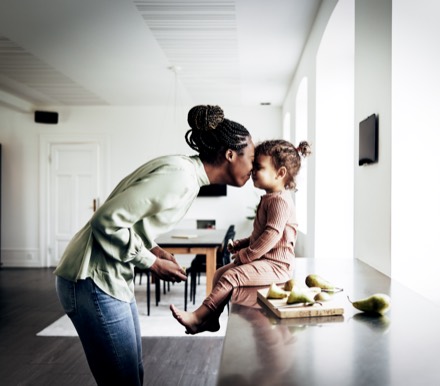
I want to be honest about the gap in the parenting advice. You've probably read that your child co-regulates off you, that they borrow your calm nervous system to settle their own, that you are the steady anchor in their storm. It's true. It's also written as though you are a bottomless well of serenity, standing there fully charged, ready to radiate peace on demand.
Some days you are not that. Some days you are also at the very edge, running on four hours of sleep and a cold coffee, and your kid melts down and the advice basically asks you to hand over a calm you flatly do not have. You can't pour from an empty cup, everyone loves to say, and then nobody tells you what to actually do when the cup is, in fact, empty and a small person still needs something from it.
Nobody is a zen robot, including you
Let's put down the fantasy first, because it's doing real damage. There is no parent who stays perfectly regulated. Not the ones in the gentle-parenting videos, not your unnervingly composed friend, not the expert who wrote the book. Everyone has a threshold. Everyone gets flooded. The composed people you're comparing yourself to are just having a good day, or they walked away for thirty seconds before the clip started, or they're falling apart about something you'll never see.
So the goal was never to become a serene, unshakeable presence at all times. That bar is fake, and reaching for it just adds shame on top of exhaustion, which helps precisely no one. The realistic goal is smaller and much kinder: to find a little pocket of calm, sometimes, enough to get through this one moment, and to repair when you don't. That's it. That's the actual job.
Rupture and repair is part of the deal, by the way. Losing it and then coming back, softer, to say "I got frustrated, that wasn't about you," teaches your kid something huge, that relationships survive hard moments. A parent who never wobbled couldn't teach that. Your imperfect days are secretly doing important work.
Borrowing calm when you have none to spare
When your own tank is empty, the trick isn't to manufacture calm you don't have. It's to borrow a little from somewhere, just enough to lend forward. Some genuinely small things that can top you up by a few degrees, mid-meltdown, with a kid attached to your leg:
- Exhale longer than you inhale. One slow breath out, longer than the breath in, actually nudges your nervous system toward settle. It's free, it's invisible, and you can do it while a child is screaming. Just one counts.
- Lower your voice instead of raising it. You often can't feel calmer on command, but you can choose the quieter volume, and your body tends to follow the choice. Act slightly calmer than you are and some real calm sometimes catches up.
- Put your back against a wall, or your feet flat on the floor, and feel the solid thing holding you. Thirty seconds of noticing you are physically supported can interrupt the spin.
- Say the true thing out loud, gently. "I'm tired and this is hard for me too." You're allowed. It doesn't scare them. It models that big feelings are survivable and nameable, which is the whole lesson anyway.
None of these fix anything. They're not supposed to. They buy you a few degrees, and a few degrees is sometimes the entire difference between a moment that spirals and one that just, barely, holds.
When you genuinely have nothing left
And then there are the days you've got nothing, not even a few degrees, and the advice list feels like one more thing you're failing at. On those days, lower the bar to the floor. Everyone safe? Nobody hurt? Then you're doing it. Screens can happen. Dinner can be cereal. The calm can be you sitting on the floor next to the chaos not fixing a single thing, just present, just breathing, just not leaving. Presence counts even when it's exhausted presence.
You don't have to be the calm. On the hard days, you just have to not disappear.
This is a lot of what we're building ThirdEyeOS around, honestly. The load you carry is part of why your tank runs dry. When the appointments and the doses and the who-picks-up-when live somewhere outside your head, your nervous system has a little more room, and that room is what you draw on when your kid needs you to be the steady one. We can't hand you calm directly. But we can carry some of the weight that's been draining it, so there's a bit more left in you for the moments that matter.
And on the days there still isn't enough, please believe this: a tired parent who stays in the room is already giving their kid the thing that counts. You do not have to be full to be enough. You just have to keep showing up, wobbly and human, which is the only way anyone has ever actually done this.